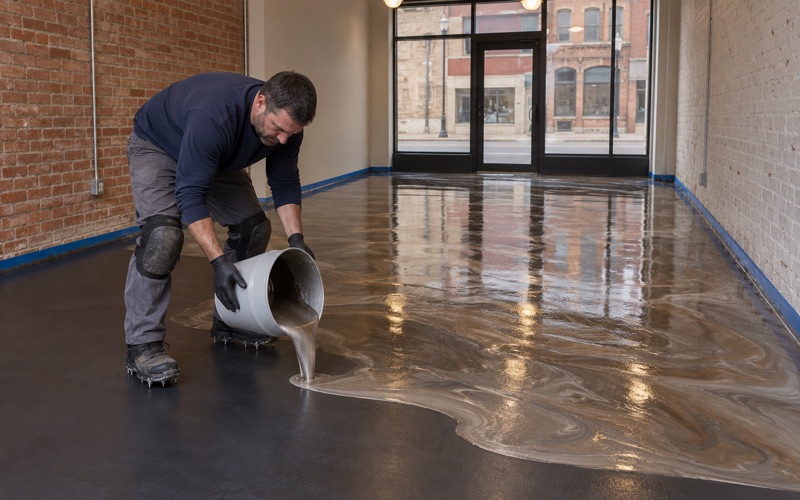
Dubuque Epoxy Flooring has put more than 20 years into concrete coatings, and our epoxy flooring in Platteville is more often for a landlord than for an owner-occupant. A rental garage or basement floor has a different job than a showroom floor. It has to stay sound and clean through tenant after tenant, and it has to be easy to keep that way between leases.
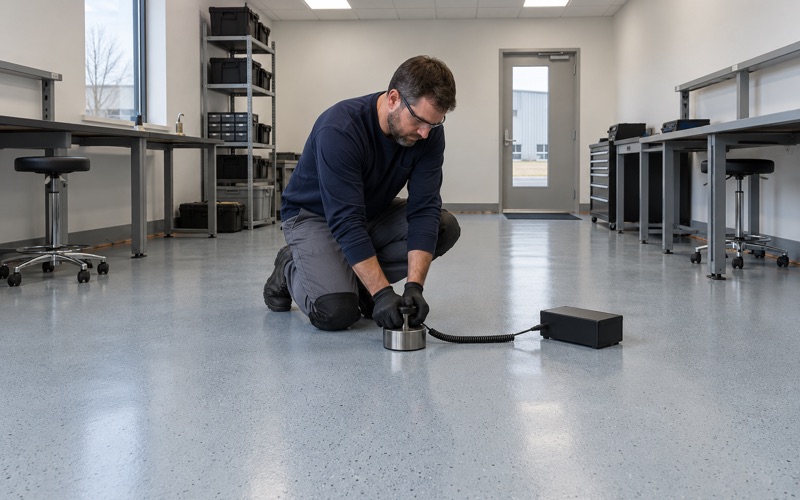
That changes how we scope the work. Before we price a floor, we map every crack, spall and patch of failing old coating, and we tell an owner plainly when a slab needs repair before anything goes on it. A moisture test is written into the scope on garage and basement slabs alike, because a coating that lets go in its second year leaves a peeling floor halfway through someone’s lease.
Our proposals name the product line, the number of coats and the finished thickness, so a property manager can hold the completed floor up against the paper. What the warranty leaves out is spelled out before anyone signs, and moisture vapor rising through the slab is the first exclusion on that list.
A Renter-Majority City With a Rental Code That Covers Floors
Most homes here are rented
Platteville is the largest city in Grant County and home to the University of Wisconsin–Platteville, and the housing count shows it. Census estimates put 2,503 of the city’s 4,134 occupied units in renters’ hands, or 60.5 percent. A good share of the rental stock sits in larger buildings, with 1,075 units in structures of 20 units or more.
That mix means much of the concrete we see in town is a rental basement, a shared garage or a ground-floor storage room in a small apartment building. The people walking on it change every year or two, and the owner answering for it is often not on site to see a problem start.
Who the city rental code covers
The city’s rental code is Chapter 33, and the copy we read is dated 2012. Its stated purpose is minimum standards for residential rental property. It does not reach everything students live in: residence halls owned by the Board of Regents and run by UW-Platteville as student housing are outside the chapter.
Private houses and apartment buildings rented near campus are another matter. Under Chapter 33, occupants keep their own part of a unit clean, sanitary and safe, while the owner maintains the structure and its fixtures. A cracked slab or a coating coming apart is a building problem, not a housekeeping one.
Floors are maintenance under this text, not decoration
Chapter 33 reads like a maintenance list. Interior surfaces are to be kept in good, clean and sanitary condition, and peeling, chipping, flaking or abraded paint is to be repaired, removed or covered. Every stair, landing, porch, deck or other walking surface is to be kept in sound condition and good repair.
None of that asks for epoxy. A coating does not make a unit compliant, and a bare, sound slab satisfies the same words. What the text does tell an owner is that a coating already on the floor becomes a maintenance item the day it starts to lift, so the choice to coat is really a choice about how long the finish will hold.
Looking for epoxy-flooring closer to The Galena Territory? See The Galena Territory Epoxy-Flooring.
Peeling Coatings and Sound Walking Surfaces Between Leases
Why rental garage coatings peel
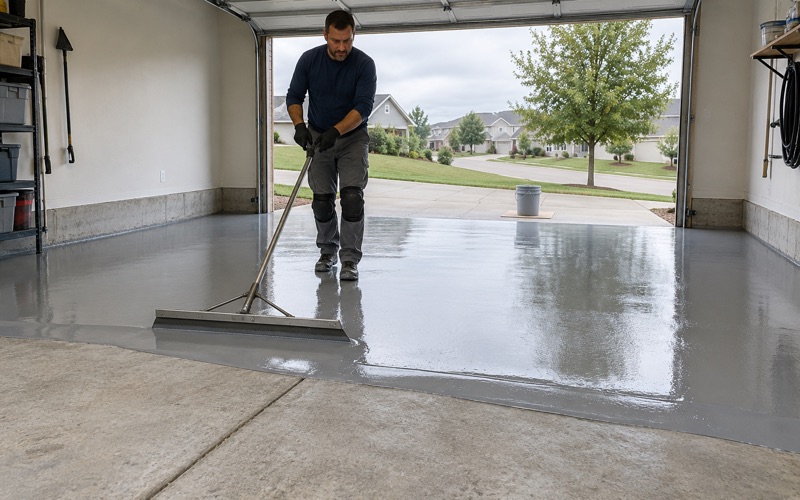
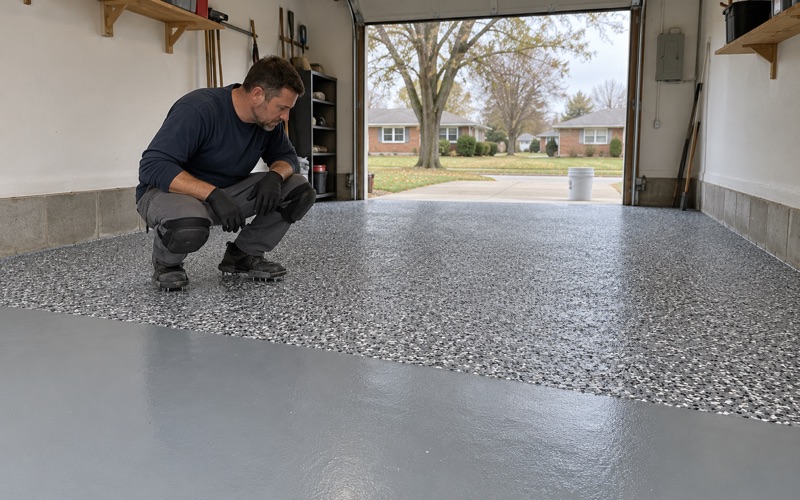
Most peeling garage floors we are called to started as a one-day kit over a slab that was acid etched or only washed. The coating had little to bite into, so hot tire pickup lifted it in patches, and the edges kept chipping from there. On a rental, that failure tends to show at move-out, when the vehicles and shelving come out and the damage is finally visible.
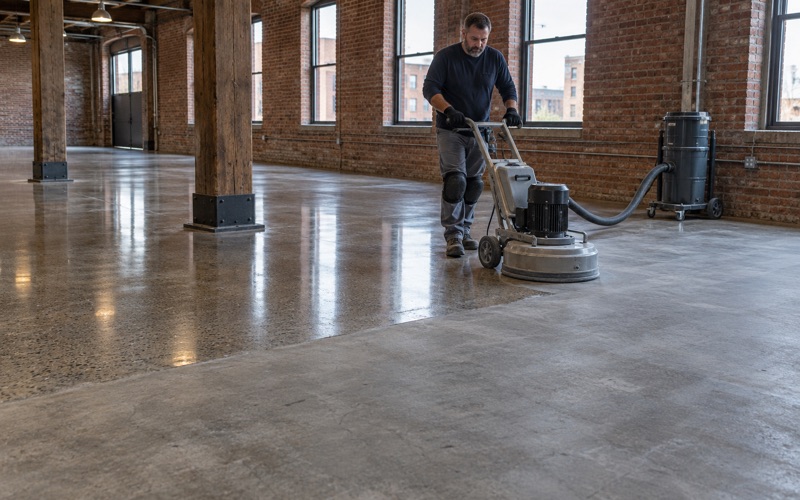
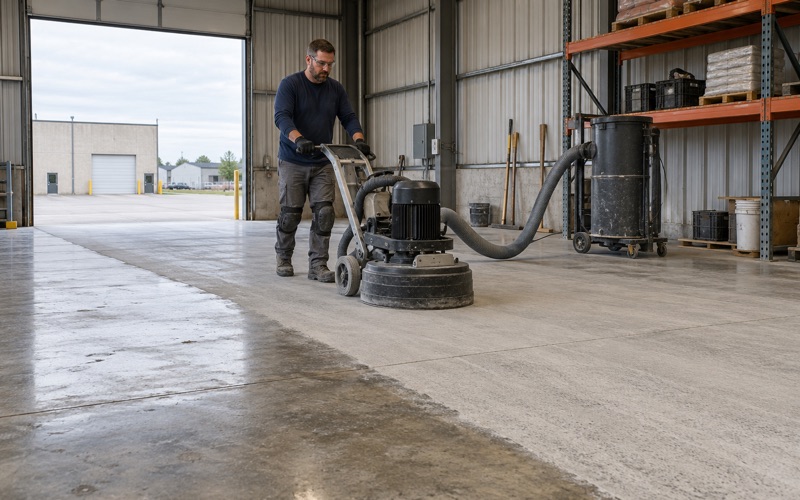
We open every slab with a diamond grinder or a shot blaster, never acid, and work to an ICRI concrete surface profile that suits the system going down. That profile is what lets a 100% solids epoxy base and a polyaspartic topcoat hold through years of cars, bikes and moving dollies.
Repairing, removing or covering a failed floor
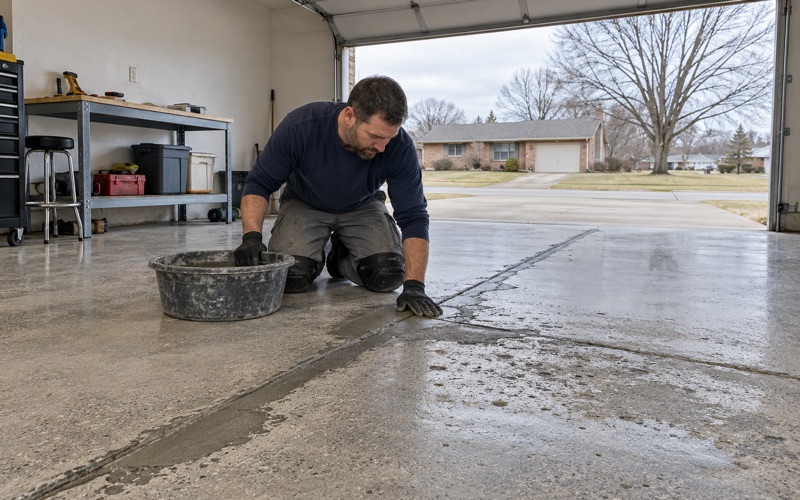
When a coating is already flaking, the rental code’s three verbs line up with three real options. A small failure can sometimes be ground back to sound edges and patched. A widespread one is removed to bare concrete. A floor that is sound underneath can be recoated over a properly abraded base.
We tell an owner which of the three a floor needs after mapping it, not before. A patch over a coating that is releasing across the whole slab only resets the clock until the next tenant moves in, and it costs nearly as much as doing the floor once and doing it right.
Timing the work around turnover
The gap between one lease ending and the next one starting is the natural window for floor work, and it is often short. A garage system can usually be prepared, coated and opened to foot traffic within that kind of window, but the schedule follows the slab rather than the move-in date.
Cure times are set by slab temperature and the dew point spread at the surface. If the concrete is too cold or moisture is condensing on it, we say so and move the date, because amine blush or a soft cure would hand the next tenant the same problem the last one had.
Texture that is specified, not promised
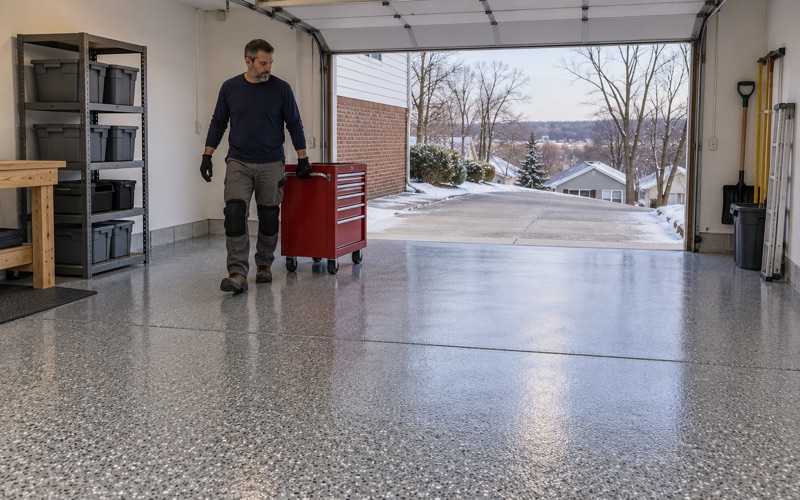
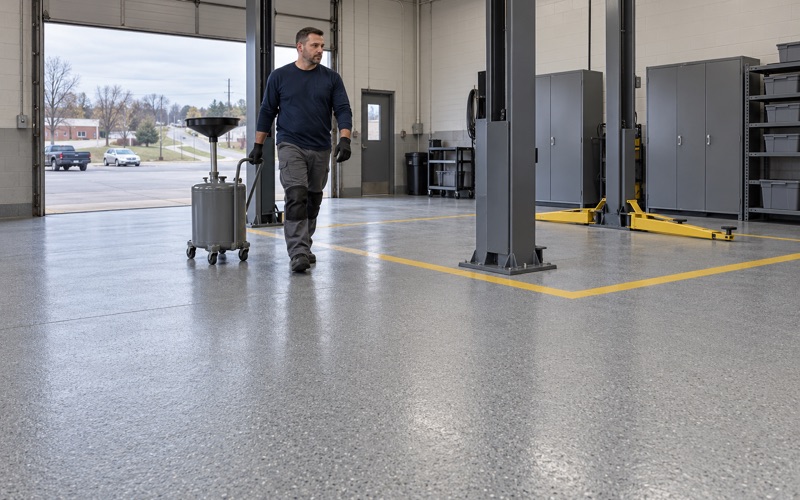
A basement landing or a garage floor that gets wet from tracked-in water needs grip as well as soundness. We specify the slip resistance by the broadcast and topcoat used, such as a vinyl flake or quartz aggregate broadcast under a textured topcoat, and write it into the proposal rather than calling the floor non-slip.
Paints and Solvents Do Not Stay in the Rental’s Garage
What Chapter 33 says about storage
Section 33.28(c) of the rental code says hazardous material is not to be stored in the dwelling unit or attached garage, and it names paints, volatile oils and cleaning fluids, except as the building and fire prevention codes allow. That is a short line with a practical effect on how floor work in a rental should end.
Partial kits, primer cans, cleanup solvent and used rags are exactly what gets left on a garage shelf for the next person. On a rental job, nothing we brought in stays behind when the crew leaves, whether the garage is attached to a single house or shared by a building.
Leftover product leaves with us
We size material to the measured floor, and whatever is not used goes back on our truck the same day. Mixed resin that has cured in the bucket, empty containers and cleanup materials are packed out rather than set aside in the attached garage for later.
That also keeps an owner from inheriting a half-gallon of topcoat that a tenant later tries to use for touch-ups. A floor touched up with mismatched product over an unprepared surface is usually the first spot to peel again.
Dust and odor in an occupied building
Many rental garages share a wall or ceiling with a lived-in unit. Our grinders run with vacuum capture at the machine, so the dust is collected rather than swept around the garage or rinsed toward a floor drain.
Low-odor products are available for attached garages and basements when neighbors will be home during the work. We offer them as a comfort and re-entry choice. Wisconsin has no state VOC rule of its own for site-applied floor coatings, so they are not a legal requirement here, only a better fit for an occupied building.
Rental Inspections and Basement Floors Since Wisconsin’s 2018 Law
What changed for rental inspections
In March 2018 the city’s community planning and development director sent the Common Council a memo on how new state legislation would affect Platteville’s rental inspection program. It counted about 2,500 licensed rental units in the city and said the program would need significant changes. We have not found what the council decided, so we do not tell owners how often a unit will be inspected.
State law now limits municipal rental inspections to complaints, district programs and a few other routes, and it defines a habitability violation to include conditions that create an unreasonable risk of personal injury. A coating curling up at the foot of a basement stair is the kind of condition a tenant notices and reports, whether or not a scheduled inspection ever comes.
Basements are read for water before anything is coated
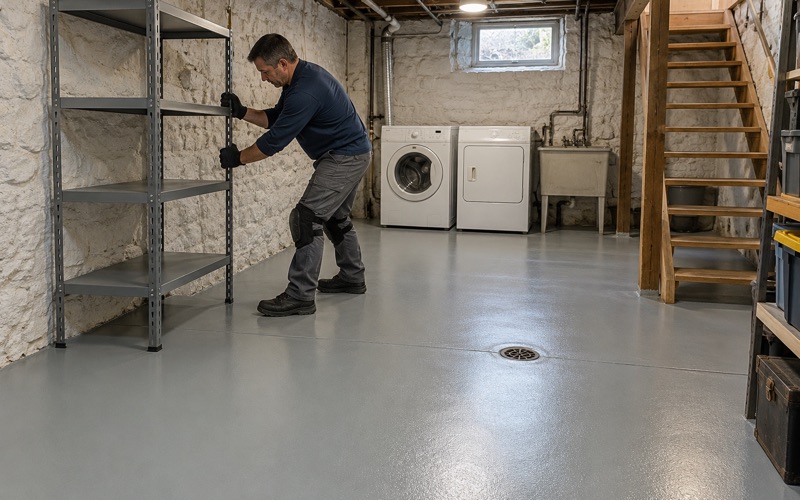
Before a rental basement floor is coated, we look for signs of past water: staining, efflorescence, and the condition of the sump pit and the floor drain. A coating does not stop seepage, and sealing a damp floor under epoxy can turn a seasonal nuisance into a peeling floor.
We pair that visual read with a moisture test written into the scope, either ASTM F2170 in-situ relative humidity probes or an ASTM F1869 calcium chloride test, and we test whatever year the house was built. If the readings call for it, a moisture-mitigation primer goes into the system. If the slab has active water, we say it should not be coated yet.
When the job is more than a finish
Coating is finish work. When a slab needs more than that, such as sections cut out and replaced or a step rebuilt, owners should ask about permits first. The city contracts building inspection to General Engineering Company, and permit applications go to GEC directly through its online portal.
We will tell an owner when a floor has crossed from a coating job into a concrete job, and we will not coat over a slab that needs replacing. Wisconsin’s ATCP 110 rules govern home improvement contracts, and ours put the full scope in writing before any grinding starts, so the owner and the next tenant both inherit a floor that matches what was agreed.
- 20+ Years on Concrete
- Moisture Tested Before Pricing
- Diamond Ground, Never Acid Etched