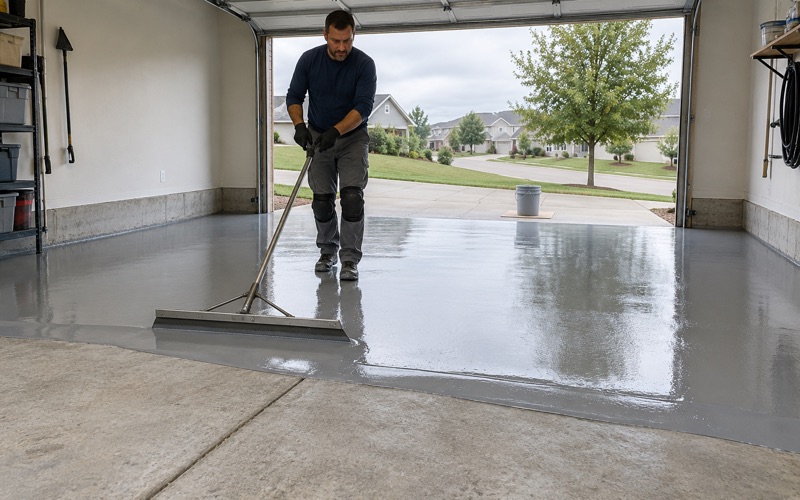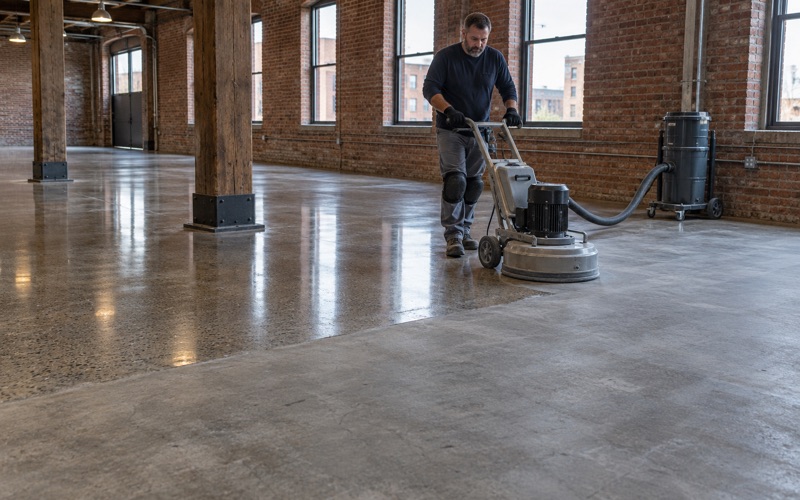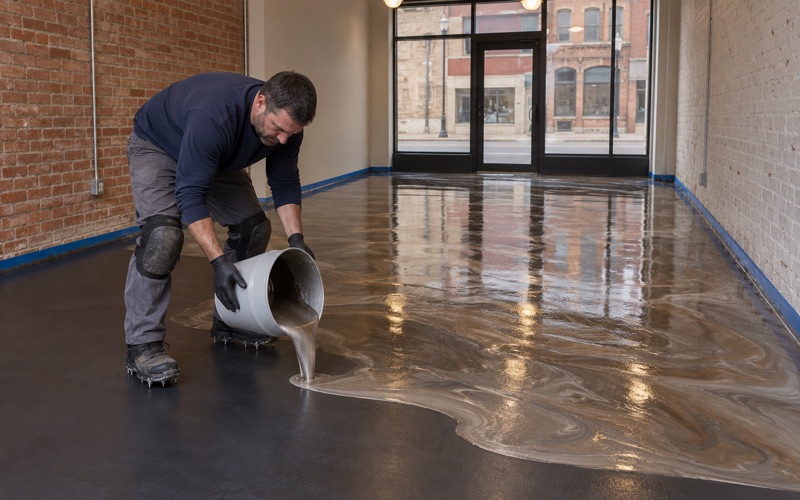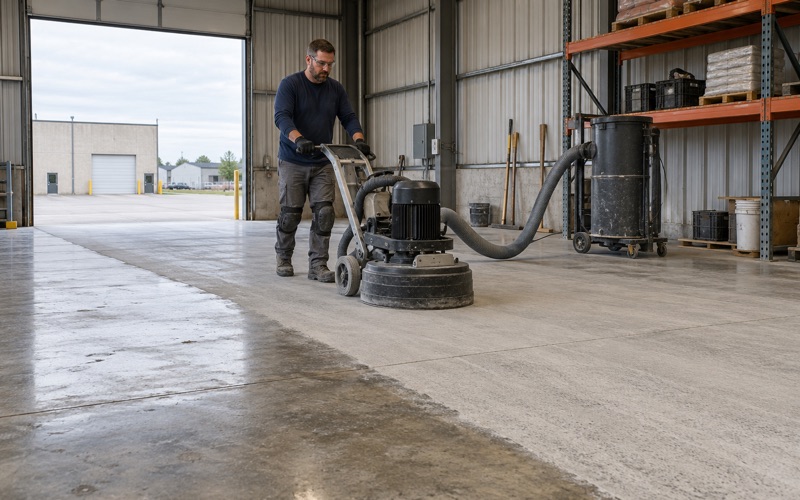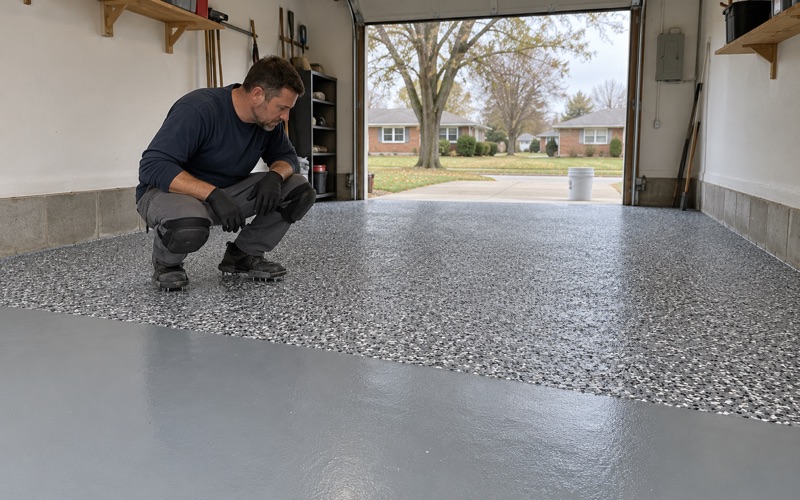
Dubuque Epoxy Flooring handles epoxy flooring in Lancaster with more than 20 years of slab work behind every quote, and every floor we coat starts the same way: the concrete is opened with a diamond grinder or a shot blaster, never an acid etch. That ground profile, read against the ICRI CSP scale, is what gives a 100% solids epoxy something real to hold.
Most of our calls here come from homeowners with a garage slab that has shed its last coating or a basement floor they finally want finished. That is a direct deal between one household and one contractor, and Wisconsin regulates it closely, so we treat the contract, the lien paperwork and the permit question as part of the job rather than an afterthought.
This page covers both halves of a Lancaster floor project. It explains how we test and prepare a slab, and it walks through the state rules that govern how the work is sold, paid for and closed out. It is a plain-language summary of public rules, written so you know what to expect from us and what to ask for.
Lancaster Homes and Wisconsin’s Home Improvement Rule
A Town Where the Owner Signs the Contract
Lancaster is the county seat of Grant County, and it is a town of owned houses. The 2024 five-year American Community Survey counts 1,279 of 1,654 occupied units as owner-occupied, about 77.3 percent, and 1,250 of those owner households live in detached houses.
That shape matters for floor work. When a garage or basement gets coated here, the person signing is usually the person who lives above the slab, not a property manager or a general contractor. That is exactly the transaction Wisconsin’s home improvement rule, ATCP 110, was written to cover, so its requirements apply to most jobs we quote in town.
Garages and Basements Are Named in ATCP 110
ATCP 110.01(2) defines a home improvement as the remodeling, altering, repairing, painting or modernizing of residential or non-commercial property. The rule’s own list names garages, basements, basement waterproofing, and attached or inlaid floor coverings. A coated garage slab or a sealed basement floor sits squarely inside that definition.
The definition does leave out construction of a new residence and major renovation, so a floor that is one line inside a whole-house build may fall under a different arrangement. A stand-alone garage or basement coating does not. We write those jobs as home improvement contracts from the first proposal, because that is what the rule says they are.
What We Test Before the Price Is Final
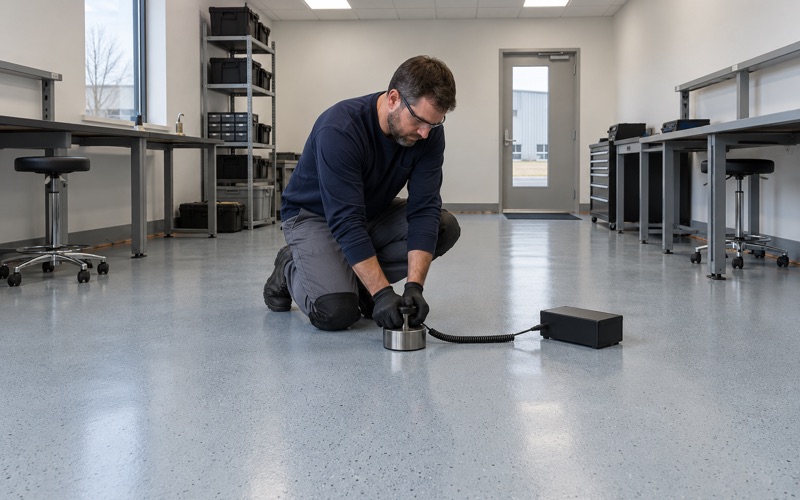
A moisture test is part of our written scope before any number is final, on a basement slab and a garage slab alike. Depending on the floor, that means ASTM F2170 in-situ relative humidity probes, an ASTM F1869 calcium chloride test, or a quick ASTM D4263 plastic sheet check. We test whatever year the house was built, because a newer house is not automatically a drier garage.
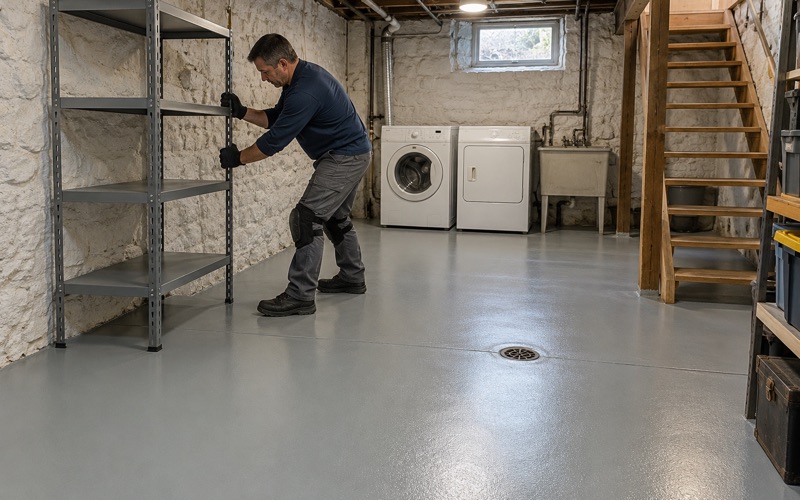
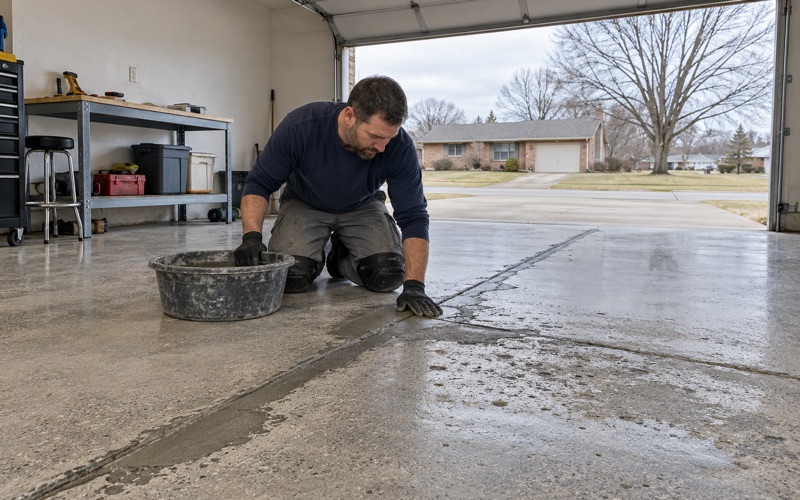
Before the price is set, we also map cracks, spalls and any old coating across the slab. Where a floor needs repair, or needs replacement before it should be coated at all, the proposal says so in plain words. In a basement we read the floor for past water first and check the sump pit and floor drain, because a coating does not stop seepage.
Looking for epoxy-flooring closer to Asbury? See Epoxy-Flooring in Asbury.
The Written Contract, the Lien Notice and the Permit Question
When the Contract Has to Be in Writing
ATCP 110.01(4) allows a home improvement contract to be oral or written, but 110.05(1) narrows that sharply. If any payment is due before the work is finished, or if the contract was solicited away from the seller’s place of business, it has to be in writing. On a floor job with a materials deposit, that covers nearly every case.
Under 110.05(2) the contract is signed by all parties and lists the seller’s name and address, a description of the work and principal materials, the total price, start and completion dates, any security interest, and any guarantee or warranty. Our proposal already names the product line, the number of coats and the finished thickness, so the floor can be checked against the paper.
The Lien Notice Comes as Its Own Page
ATCP 110.025(1) requires the seller to hand the owner a lien notice as a separate document, written in a clear and conspicuous font, and to keep evidence that the owner received it. It cannot be buried in the fine print of the contract. We give it as its own sheet and ask for a signed receipt, which we keep with the job file.
The notice exists because Wisconsin lets people who supply labor or materials to a property claim a lien against it if they go unpaid. A homeowner who pays the contractor in full can still face a claim if the contractor does not pay a supplier. The separate notice makes sure that risk is explained before any money changes hands, not after.
Permits Disclosed Before Signing
ATCP 110.03(1) says the seller must disclose any required permits before the contract is signed, and that no work may start until all required state and local permits have been issued. Under 110.03(2), the owner is also entitled to copies of inspection certificates before final payment. Our proposals carry a permit line so this is settled before a grinder is unloaded.
The City of Lancaster contracts its building inspection to Josh Copsey of General Engineering Co., who keeps office hours from 8:30 to 10:00 a.m. on Wednesdays at City Hall, 206 S. Madison Street. Building and zoning permits run through GEC’s online portals. A coating over a sound slab and a full slab replacement may get different permit answers, so we ask GEC rather than assume.
Lien Waivers With Each Payment
What a Lien Waiver Covers
ATCP 110.025(2) gives the owner a further right: on request, the seller must provide written lien waivers from every contractor, subcontractor and material supplier on the job, and that applies to partial payments as well as the final one. Each waiver is a signed statement that the party has been paid for what it furnished up to that point.
On a typical Lancaster garage floor, the parties who could furnish something are fewer than on a remodel. There is our crew, the coating manufacturer or distributor supplying the resin, flake and topcoat, and occasionally a concrete repair supplier. When an owner asks for waivers, we collect them from each of those with every payment, so nobody is left holding an unanswered invoice.
How Payments Line Up With the Work
Floor jobs usually run in two or three payments: a deposit for materials, sometimes a draw after grinding and repair, and a final payment at completion. ATCP 110.02(6)(e) bars a contractor from demanding final payment, or asking the owner to sign a completion slip, before the work is actually done. We schedule the last invoice for after the topcoat has cured and been walked.
The contract is also where the warranty belongs, and we explain what a coating warranty leaves out before the job is sold. Moisture vapor transmission and hydrostatic pressure under the slab are the first exclusions we name, which is one more reason the moisture test comes before the price. An owner who reads the exclusions early is not surprised by them later.
Winter Timing and Road Salt
Cure schedules on our jobs follow slab temperature and the dew point spread at the slab surface, not the calendar. A cold, damp slab invites amine blush on epoxy and a weak bond under the topcoat. When an unheated garage in deep winter cannot hold temperature through the cure, we tell the owner to wait, and the start date in the written contract reflects that.
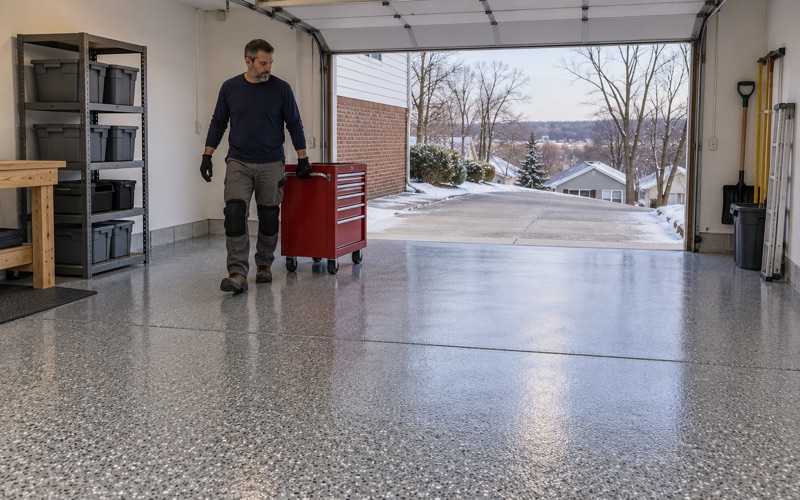
Garage systems here are chosen for the brine and rock salt that ride in on tires from November through March. A full flake broadcast under a polyaspartic or polyurea topcoat resists hot tire pickup and stands up to calcium chloride deicers better than a thin roll-on kit. The slip-resistant texture comes from the broadcast and topcoat we specify, and the proposal names both.
Lien Claims, the 30-Day Notice and the Courthouse in Lancaster
The 30-Day Notice of Intent
If a lien claim does arise, Wis. Stat. 779.06(2) sets a warning step first. At least 30 days before filing the claim, the lien claimant has to serve the owner with a written notice of intent to file a lien claim. For an owner, that notice is the signal that someone on the job believes they have not been paid.
The gap between notice and filing is when the job file earns its keep. A signed waiver from the party that sent the notice, a receipt for each payment and the separate lien notice give an owner documents to bring to that conversation. The statute itself is short, and the ATCP 110 paperwork is what an owner will want to have on hand.
Filing With the Clerk of Circuit Court
Under 779.06(1), a lien claim is filed in the office of the clerk of circuit court of the county where the land lies, within six months from the date the claimant last performed, furnished or procured labor or materials. Any court action on that claim follows within two years of filing. For a house in Lancaster, the county is Grant County and the office is in town.
The Grant County Clerk of Circuit Court sits at 130 W. Maple Street in Lancaster, near the Grant County Courthouse at 126 West Main Street. The courthouse, a copper-domed Classical Revival building of red sandstone built in 1902, anchors the square. Living in the county seat means the office that would hold any lien filing on your land is across town, not a county away.
Keeping Your Own File
We hand every Lancaster customer a complete set at the end of a job: the signed written contract, the receipt for the separate lien notice, any lien waivers requested, permit records if a permit was required, and copies of inspection certificates. That folder answers most questions a later buyer, lender or title company might ask about the floor.
Everything above is a plain-language summary of public rules, not an interpretation of how they apply to a particular dispute. A question about a specific lien claim belongs with an attorney. Our part is simpler: sell the floor in writing, say what the slab needs, capture the grinding dust at the machine, and hand over each document the rule names when it is due.
- 20+ Years on Concrete
- Moisture Tested Before Pricing
- Diamond Ground, Never Acid Etched