
Dubuque Epoxy Flooring has installed epoxy garage floor systems for 20+ years in Dubuque, IA, serving surrounding cities including Asbury, Platteville, The Galena Territory, Dyersville and Lancaster. We grind every garage slab with diamond tooling, test it for moisture, and build a coated floor meant to take tire traffic, dropped tools and a long salt season.
A garage floor fails from the bottom up far more often than from the top down. Peeling at the tire lines, white blisters and bubbling near the door almost always trace back to a slab that was etched instead of ground, coated while damp, or coated too cold. Our process is set up to deal with each of those before the first coat is mixed.
Before any price is final, we walk the garage with you, map every crack and spall, and run a moisture test on the slab. The written proposal then names the product line, the coats and the finished thickness, so you can hold the finished floor against what you were quoted.
Preparing the Garage Slab
Diamond Grinding to a Real Profile
We open the surface with a diamond grinder, or a shot blaster on larger slabs, to a profile in the ICRI CSP range the coating maker specifies. That removes curing compounds, old sealer and the weak top paste of the concrete, and gives the base coat a texture to lock into.
The grinder runs with a vacuum attached, so the dust is captured at the machine instead of drifting into the house or being rinsed toward a drain. Edges along walls and around posts get the same treatment with hand grinders, since coatings tend to fail first where preparation was skipped.
Mapping Cracks, Spalls and Pitting
Before grinding we chalk out every crack, spall and pit so they are not lost in the dust. Spalled edges near the door are common where salt and freeze-thaw have worked into the surface, and pitting often shows up in front of where cars park.
Each defect is filled with a repair material made for the coating system and ground flush. If a section has heaved, settled or broken loose, we tell you it needs replacement first, because coating over a moving slab only buys a few months.
Old Paint, Sealer and Failed Kits
Many garages already carry a peeling store-bought kit, a coat of floor paint or a shiny acrylic sealer. None of them is a safe base for a new system. We grind through all of it to bare, sound concrete, and test any area where the old coating was holding stubbornly to see what it is bonded to.
Oil and fluid stains get the same scrutiny. Oil that has soaked deep into the slab can keep weeping up under a new coating, so we degrease and grind stained areas and check whether the contamination goes deeper than the grind can reach.
Moisture, Temperature and the Cure
Testing a Garage Slab for Moisture
We start with an ASTM D4263 plastic sheet test and move to ASTM F1869 calcium chloride kits or ASTM F2170 relative humidity probes when the slab looks suspect. The readings are compared with the coating maker’s limits, and the result decides the base coat. A slab over the limit gets a moisture-mitigation primer or a frank conversation about whether it should be coated.
The test is written into the scope before the price is final, not offered as an upsell after a problem appears. Moisture is also the first thing a coating warranty excludes, so knowing the reading protects you as much as it protects the floor.
Why a Newer Garage Can Still Be Damp
IRC R506.2.3 lets a garage slab be poured without the vapor retarder required under a living space, and many are. A slab with no retarder over damp soil can push vapor for years. That is why we test new construction as readily as a 1950s garage, rather than assuming a newer house means a drier floor.
Slab Temperature and Dew Point
Epoxy and polyaspartic cure by chemistry, and that chemistry slows sharply on a cold slab. If the slab surface sits close to the dew point, moisture condenses on it and the coating can cloud or develop amine blush, a greasy film that hurts the next layer’s bond.
We measure the slab temperature and the dew point spread on install day and set the schedule from those readings, not from the calendar. Dubuque’s last spring freeze typically comes around April 28, so an unheated detached garage often waits until the slab warms up.
Building the Garage Floor System
A High-Solids Epoxy Base Coat
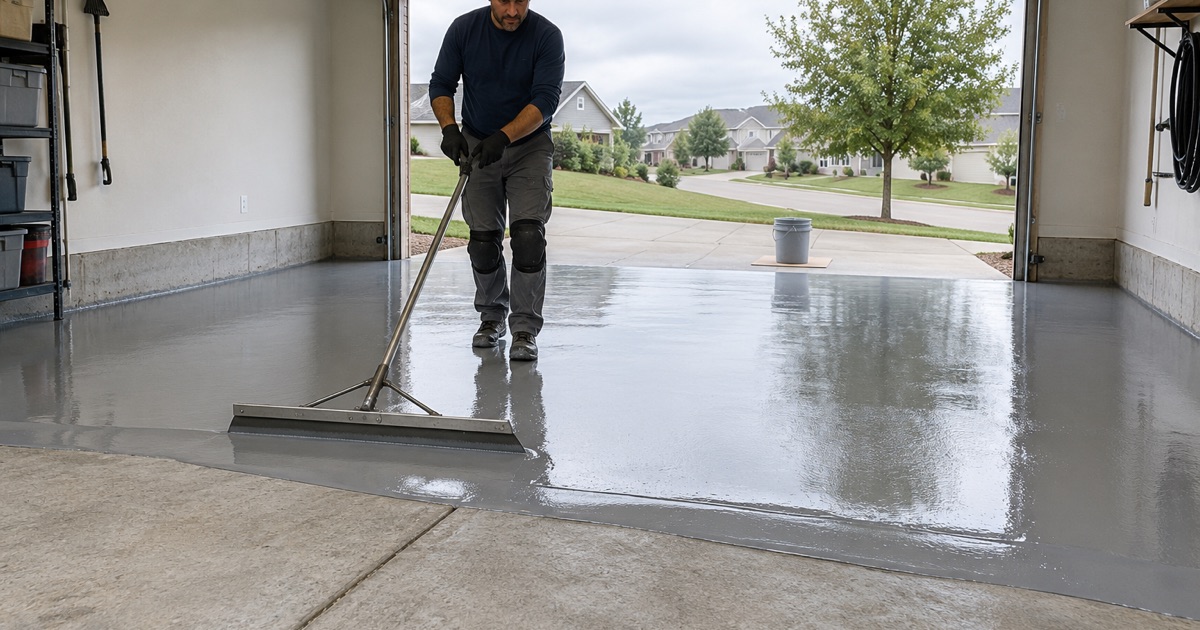
The base coat carries most of the bond and much of the thickness. We use a 100% solids epoxy for that layer on most garages, since it builds thickness in one pass and does not shrink as solvent or water evaporates. It goes on over the repaired, ground slab and wets into the profile.
The proposal lists the base coat product and its thickness alongside the flake and topcoat, so the system can be compared line by line with any other quote. A thin water-based kit and a high-solids base are not the same floor, even when they look alike on the day they go down.
Vinyl Flake Broadcast and Color
While the base coat is wet we broadcast vinyl flake, usually to full coverage so no base color shows. The chips add texture, hide small slab flaws and make dust and tire marks harder to see. Once cured, the loose flake is scraped and vacuumed, and the surface is ready for the clear topcoat.
Chip size and blend change the look a lot. Small chips read as a tight speckle, while larger chips give a bolder pattern. We bring sample boards so you can see the blends against your garage lighting.
Polyaspartic Topcoat
The topcoat takes the wear, the salt and the sunlight. We usually finish garages with a polyaspartic or polyurea topcoat, which resists ultraviolet ambering better than epoxy and handles chemicals and abrasion well. Gloss, satin or a grit additive can be chosen at this stage to set the final look and grip.
A Coated Garage Through Salt Season
Brine and Rock Salt on the Floor
From November through March, cars bring in calcium chloride brine and rock salt that soak into bare concrete and help freeze-thaw cycles scale the surface. On a coated floor that slush sits on top, where a squeegee and a rinse can move it out the door. We choose garage topcoats with that exposure in mind.
Hot Tire Pickup
A warm tire pulled into a cold garage can soften a thin coating and lift it when the car drives off. Hot tire pickup is a classic failure of thin, low-solids kits over etched slabs. A ground slab, a high-solids base and a hard topcoat give the bond and thickness to resist it.
Timing matters too. A topcoat that has not reached its full cure is softer than it will be in a few weeks, so we give a drive-on time for your floor and ask that cars stay off until then, especially on a cool slab.
Cleaning and Care
A coated garage floor is cleaned with a soft mop or a floor squeegee and a mild cleaner. Avoid acidic cleaners and harsh solvents unless the product sheet allows them. A pad under a kickstand or jack stand keeps point loads from denting the topcoat, and salt residue is easiest to deal with before it dries.
- 20+ Years on Concrete
- Moisture Tested Before Pricing
- Diamond Ground, Never Acid Etched