
Dubuque Epoxy Flooring installs ESD flooring in Dubuque, IA for electronics assembly, labs, server rooms, control rooms and other spaces where static discharge can damage parts or equipment, serving surrounding cities including Asbury, Platteville, The Galena Territory, Dyersville and Lancaster. We have been preparing and coating concrete for 20+ years, and static-control floors demand the most careful preparation of any system we install.
An ESD floor is a coating built to carry static charge safely to ground rather than letting it build up on people and carts. A static spark too small to feel can damage sensitive electronics, and in some settings it can be a safety hazard. The floor is one part of a static-control program that also includes footwear, workstations and procedures.
We start with the resistance range your operation needs, the standard you work to and how the room is used. The written proposal names the system, the grounding layout and the testing we will do, so the finished floor can be checked against the specification.
Static-Dissipative and Conductive Floors
How an ESD Floor Works
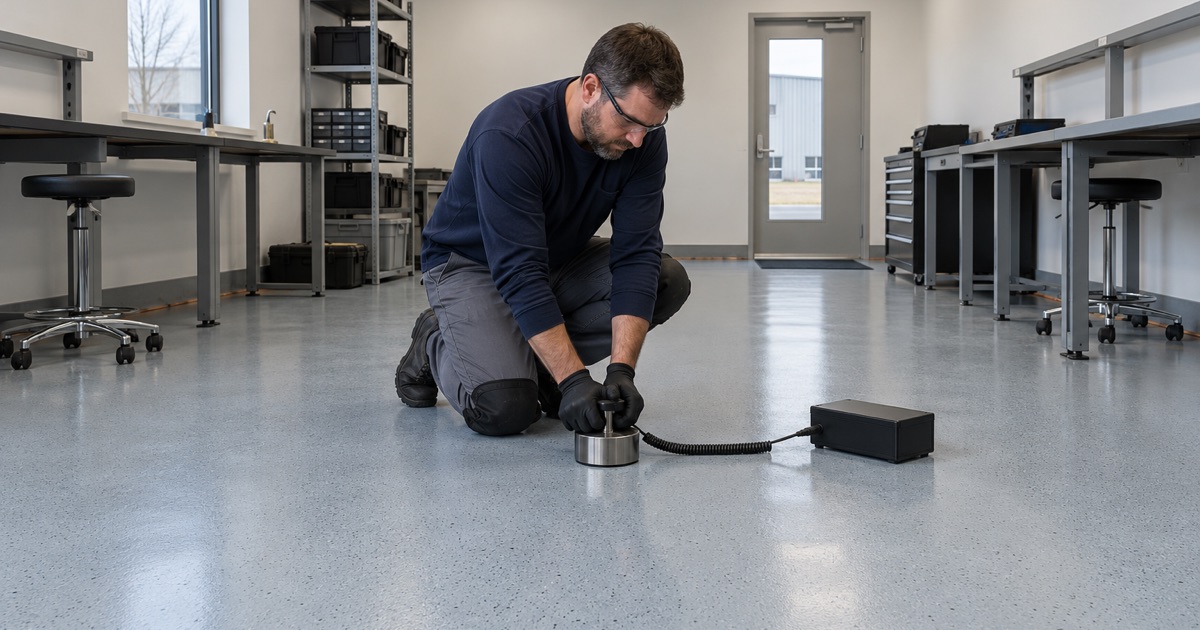
A standard epoxy is an insulator, so charge on a person or cart has nowhere to go. An ESD floor includes conductive materials that give the charge a controlled path through the coating to grounding points tied into the building ground. The charge drains away instead of jumping to a part or a device.
The resistance of that path matters. If it is too high, charge drains too slowly. If it is too low for some applications, current can flow too quickly. The right range depends on what is being protected.
Static-Dissipative Systems
Static-dissipative floors have a higher resistance range than conductive floors and drain charge at a controlled rate. They are common in electronics assembly, labs and server rooms where people and carts move between workstations.
Conductive Systems
Conductive floors have a lower resistance range and move charge to ground quickly. They are used where the specification calls for them, such as some sensitive electronics work and certain hazardous areas. We install the system your specification or safety team calls for, rather than choosing one on our own.
Choosing the Right Range
The resistance range is set by your industry standard, your customers’ requirements or your own safety program. We ask for that specification before quoting. If you do not have one, we suggest you settle it with your quality or safety team, since the floor should match the rest of your static-control program.
Preparing the Slab and Grounding
Grinding to Bare Concrete
ESD systems need a clean, sound slab with old coatings removed. We grind with diamond tooling to the profile the system calls for and capture the dust at the machine. Cracks, spalls and joints are repaired so the conductive layers can be laid evenly.
Uneven thickness can cause uneven resistance, so flatness matters here more than on many floors. We pay close attention to low spots and patches before the first layer goes down.
Moisture Testing
Moisture coming through a slab can blister an ESD coating like any other, and it can also affect how the system performs. We test with ASTM F1869 calcium chloride kits or ASTM F2170 relative humidity probes and use a moisture-mitigation primer where the readings call for one. Coating warranties generally exclude moisture failures, and we explain that exclusion before the job is sold.
Grounding Points and Conductive Primer
Copper grounding strips are laid on the prepared slab and connected to grounding points that tie into the building ground. A conductive primer then spreads the path across the floor, so every part of the surface has a route to ground.
The number and spacing of grounding points follow the system maker’s requirements and the size of the room. We work with your electrician where a new ground connection is needed.
Installing and Testing the System
The ESD Coating Layers
The ESD body coat carries conductive fibers or fillers that link the surface to the primer below. It is applied at a controlled thickness, since thickness changes resistance. A smooth surface is typical, though some texture can be added where wet areas call for it.
Color is usually limited compared with decorative floors, and some ESD systems show fine visible fibers. We show you samples so you know how the finished floor will look.
Resistance Testing
Once cured, the floor is tested with a resistance meter, point to point across the surface and from the surface to ground, at locations spread across the room. The readings are recorded and given to you. That record is your baseline for future audits and for checking the floor after cleaning or repairs.
Footwear and Workstations
The floor only works if charge can reach it. People need ESD footwear or heel grounders, carts need conductive wheels or drag chains, and workstations need their own grounding. We explain how the floor fits into that system, though footwear and workstation programs are yours to manage.
Keeping an ESD Floor in Range
Cleaning Without Insulating
Most waxes, polishes and some general cleaners leave an insulating film that can push an ESD floor out of range. We leave written instructions naming the cleaners made for ESD floors and the ones to avoid.
It helps to share those instructions with any outside cleaning service. One wrong product applied across the floor can undo the resistance readings, and stripping that film is far more work than avoiding it.
Periodic Testing
Wear, contamination and changes in humidity can shift readings over time. Regular testing against the baseline shows when an area needs cleaning or repair. Damaged or worn areas can often be repaired and retested without recoating the whole room.
Rooms That Combine Uses
Some buildings need ESD flooring in only part of a space, such as an assembly area within a larger shop. We can install ESD and standard systems side by side, with a clear transition and grounding layout, so the static-control area is clearly defined.
- 20+ Years on Concrete
- Moisture Tested Before Pricing
- Diamond Ground, Never Acid Etched