
Dubuque Epoxy Flooring handles concrete grinding in Dubuque, IA as the first step of every floor we coat or polish, and as a stand-alone service for slabs that need old coatings removed or high spots flattened, serving surrounding cities including Asbury, Platteville, The Galena Territory, Dyersville and Lancaster. We have been grinding and preparing concrete for 20+ years.
Surface preparation decides whether a coating lasts. A coating is only as strong as its bond, and the bond is only as good as the surface it grips. Grinding removes the weak top layer, sealers and contaminants and opens the concrete to a measured texture the coating can lock into.
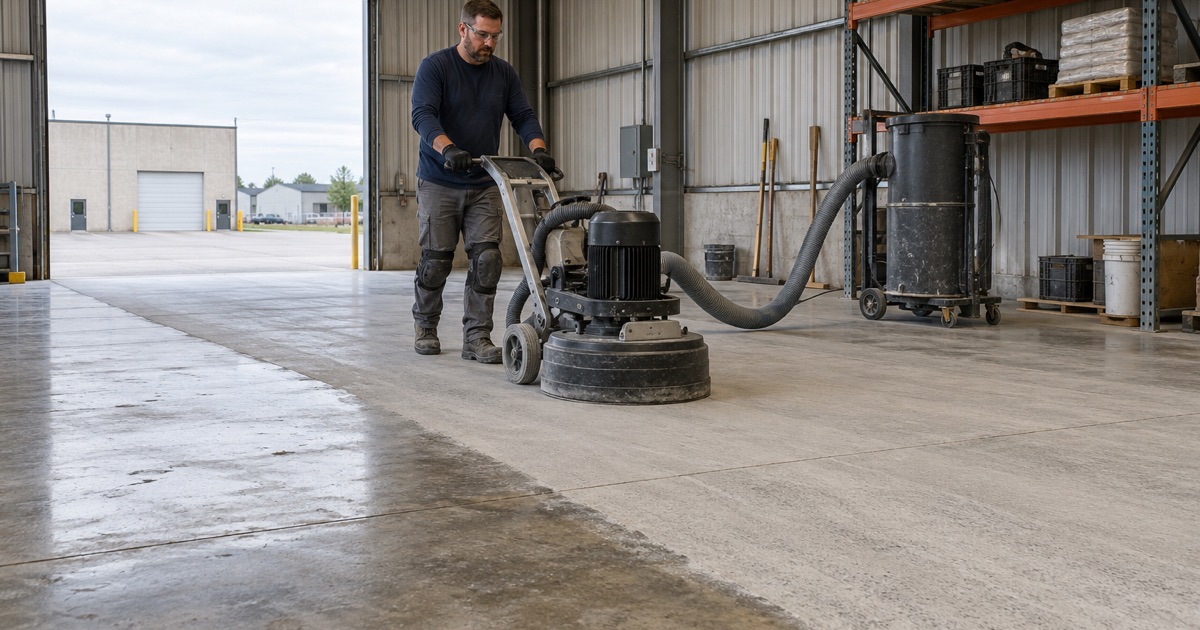
We use diamond grinders and shot blasters sized to the job, with vacuums attached at the machine. That keeps dust out of the air and out of the drains, and it lets us check the finished profile against the coating maker’s specification before anything is applied.
What Concrete Grinding Does
Removing the Weak Surface Layer
The top of a troweled slab is often a thin layer of cement paste called laitance, which is softer and weaker than the concrete below. Curing compounds and sealers sit on top of that. Coatings applied over this layer tend to peel because the layer itself fails, not the coating.
Grinding cuts through that surface to sound concrete. The result is a clean, open surface that absorbs primer and gives the base coat something solid to hold.
Creating a Measured Profile
The International Concrete Repair Institute defines concrete surface profiles on a scale from CSP 1, nearly smooth, to CSP 10, very rough. Each coating system calls for a range on that scale. Thin coatings want a lighter profile, while thick systems and urethane cement need a deeper one.
We choose the tooling to reach the profile your system calls for and compare the ground surface with reference chips. That way, the preparation matches the product rather than being a guess.
Flattening and Leveling
Grinding also removes high spots, ridges and trowel marks. Metallic epoxy and polished concrete both need a flat slab, because coatings pool in low spots and polish shows every wave in the surface. Grinding first gives those finishes the base they need.
The same work removes trip edges where one slab section has settled slightly below the next. We can feather the higher edge down into the lower one, which is often far cheaper than replacing the section. Where the offset is large or still moving, grinding is only a short-term answer, and we say so.
Grinding, Shot Blasting and Acid Etching
Diamond Grinding
Diamond grinders use rotating heads fitted with diamond segments. They work well in garages, basements and rooms with walls and corners, and they can remove coatings, flatten slabs and create light to medium profiles. Edge grinders reach along walls and around posts where a large machine cannot.
The segments come in different bonds and grits for hard and soft concrete and for removing coatings rather than cutting the slab. Choosing the right tooling for the slab in front of us is what keeps the profile even and avoids gouging soft spots or glazing over hard ones.
Shot Blasting
Shot blasting throws steel shot at the slab and collects it again with the dust. It is fast on large open floors such as warehouses and plants and creates a deeper, more uniform profile. It is less suited to small rooms and leaves a pattern that thin coatings can show, so we pick it where its strengths fit.
On many commercial jobs we use both. The shot blaster covers the open field of the floor quickly, and diamond grinders handle the edges, corners, ramps and areas around equipment bases. The two profiles are matched so the coating sees a consistent surface from wall to wall.
Why We Do Not Acid Etch
Acid etching is common with store-bought kits. It leaves an uneven, shallow profile, does nothing about sealers or old coatings, and soaks the slab with water that must dry before coating. On a basement or garage slab that may already carry moisture, that is the wrong direction to go.
Removing Old Coatings and Adhesives
Paint, Epoxy and Sealer
Many floors already carry a failed kit, floor paint or a glossy acrylic sealer. None of these is a sound base for a new coating, even where it seems well bonded. We grind all of it off to bare concrete and look closely at areas that resist removal.
An area where the old coating clings stubbornly can mean it was bonded well, or that something under it is different from the rest of the slab, such as a patch or a sealer. Either way, we want to know before the new system goes down, so a test patch is ground and checked first.
Tile Adhesive and Thinset
Floors that once held tile, carpet or vinyl often carry adhesive, thinset or mastic. Dubuque has a large share of older homes, with 45.7 percent of housing units built before 1960, and many of those basements hold layers of old flooring residue. Some older black mastics contained asbestos, so we test suspect adhesive before anyone grinds it.
Oil and Contaminated Concrete
Oil, grease and coolant soak into concrete in garages and shops. Grinding removes surface staining, but deep contamination can keep seeping up under a coating. We degrease, grind and test those areas, and tell you when a section is too contaminated to coat reliably.
A simple water drop test helps here. Water that beads on a ground surface instead of soaking in points to oil or sealer still in the concrete. Those spots get more grinding or cleaning until the slab absorbs water evenly, which is a sign it will take primer evenly too.
Dust, Debris and Clean Work
Dust Captured at the Machine
Every grinder and shot blaster we run is connected to an industrial vacuum. Dust is pulled away at the cutting head instead of drifting through the room. In homes we close off doors to the living space, and in businesses we plan around people and equipment working nearby.
Keeping Residue Out of Drains
Grinding residue does not belong in a floor drain, a sump or a storm inlet. Concrete slurry and fine dust are solids that settle in pipes and can clog a line, and old coating residue is not something to send into the sewer. We vacuum, bag and haul away the debris instead of rinsing it out the door.
- 20+ Years on Concrete
- Moisture Tested Before Pricing
- Diamond Ground, Never Acid Etched