Dubuque Epoxy Flooring installs commercial epoxy flooring in Dubuque, IA for retail stores, offices, clinics, gyms, auto service bays and common areas, serving surrounding cities including Asbury, Platteville, The Galena Territory, Dyersville and Lancaster. After 20+ years of grinding and coating concrete, we know a commercial floor has to look right, wear well and go down without shutting the business for a week.
A business floor carries more feet, more wheels and more cleaning than a house. It also comes with tighter schedules, people working nearby and customers who will notice dust, odor or a slippery entry. The coating system and the schedule have to answer all of that at once.
We start by looking at the slab, the traffic, the cleaning routine and the hours the building is open. The written proposal then names the product line, the coats and the finished thickness for each area, along with the schedule we agree on.
Commercial Floors We Coat
Retail, Showrooms and Offices
Retail floors and showrooms need a finish that looks good under bright lights and holds up to carts and foot traffic. Flake, quartz and metallic epoxy systems all suit these spaces, sealed with a polyaspartic or urethane topcoat that resists scuffs and ultraviolet ambering near windows.
Office floors and corridors often use solid colors or flake in muted blends that hide everyday wear. Where a floor will sit under rolling chairs and furniture, we choose a topcoat with good scratch resistance and a sheen that hides fine marks.
Saw-cut borders, inset logos and color-coded zones can also be built into the floor. They are planned before grinding starts and placed with the existing control joints in mind, so the design lines up with the slab instead of fighting it.
Auto Service Bays and Dealerships
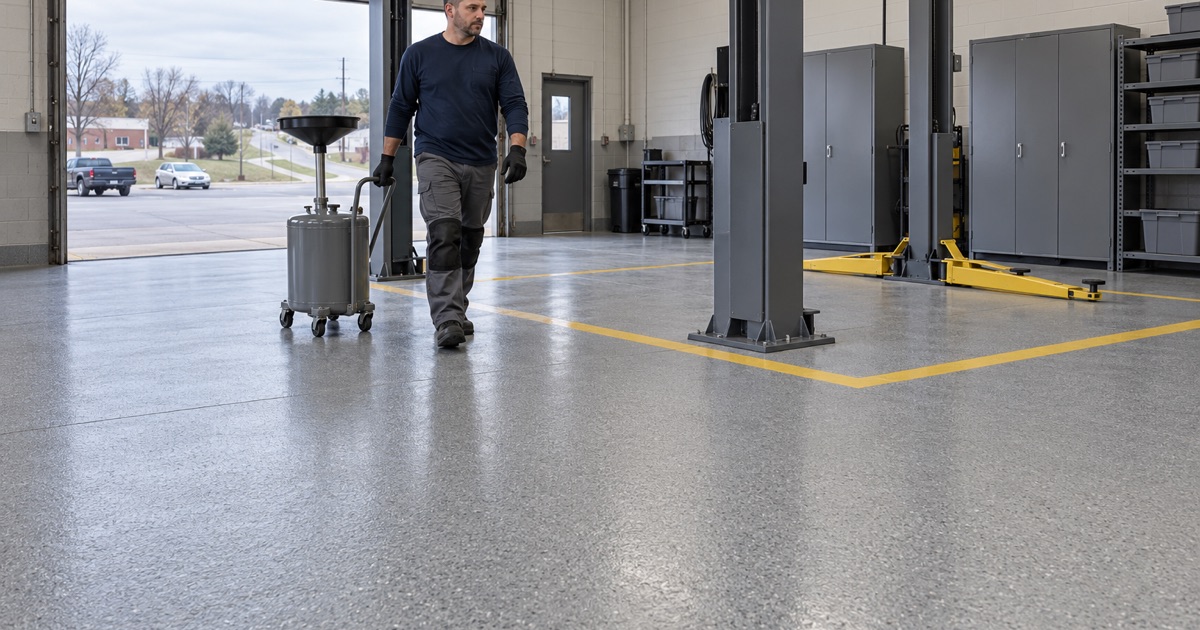
Service bays face oil, coolant, brake fluid, hot tires and heavy jacks. Floors there need chemical resistance, a durable topcoat and texture that stays safe when wet. We build those systems with a high-solids epoxy base and a broadcast and topcoat chosen for the fluids in that shop.
Winter adds salt and slush carried in on vehicles. Coated bay floors keep that brine on the surface where it can be squeegeed to the drain, instead of soaking into bare concrete and scaling it over many freeze-thaw cycles.
Gyms, Clinics and Common Areas
Gyms need floors that handle dropped weights, sweat and frequent cleaning, often with rubber mats over parts of the floor. Clinics and medical offices need seamless, cleanable surfaces. Common areas, stairwells and restrooms need durable, slip-resistant finishes that look tidy for years.
We match the system to each space within a building. One job can include a decorative lobby, a textured restroom and a hard-wearing back room, each written into the proposal as its own area.
Preparing a Commercial Slab
Grinding and Shot Blasting
We open commercial slabs with diamond grinders or shot blasters to the concrete surface profile the coating maker specifies. Shot blasting covers large open areas quickly, while grinders handle edges, corners and rooms with fixtures. Both run with vacuums attached so dust stays out of the building.
Moisture Testing
Commercial slabs on grade may have no vapor retarder or one that has failed. A coating over a damp slab can blister, and coating warranties generally exclude failures from moisture vapor transmission and hydrostatic pressure. We test with ASTM F1869 calcium chloride kits or ASTM F2170 relative humidity probes and choose a moisture-mitigation primer when the readings call for one.
The test result goes into the written scope before the price is final. That way, the cost of dealing with moisture is known up front instead of appearing as a change order after the floor fails.
Cracks, Joints and Old Coatings
Commercial floors often carry old coatings, adhesive from removed flooring and spalled joints. We map all of it, remove old material to sound concrete, and rebuild damaged joints. When part of a slab is too damaged to coat, we say so and explain the repair before the job is sold.
Scheduling Around the Business
Phasing by Area
Most businesses cannot close for several days. We split the floor into areas and coat them in sequence, keeping the rest of the building open. Temporary walls, sealed doorways and planned walkways keep customers and staff away from wet coatings.
The order of the areas matters as much as the speed. We usually start in back rooms and storage, move through work areas, and finish at the entry, so the space customers see last is the one coated most recently. Each phase is signed off before the next begins.
Nights and Weekends
Where a business needs every daytime hour, we work overnight and on weekends. Fast-curing polyaspartic topcoats let an area go back into use sooner than a full epoxy build. We give you return-to-service times in writing for each area.
Odor and Occupied Buildings
Coatings can give off odor while curing, which matters in an occupied building. We offer lower-odor products and ventilate during the work. In Iowa and Wisconsin that is a comfort choice under the federal 40 CFR 59 Subpart D rule, and on Illinois jobs we select products that meet the state’s own VOC limits.
Slip Resistance and Upkeep
Texture Where Floors Get Wet
Entries, restrooms and service bays see water, snowmelt and spills. A smooth gloss coating can be slick under those conditions, so we specify texture by area, using quartz or flake broadcasts and grit in the topcoat. The texture is written into the proposal rather than promised in general terms.
Cleaning a Coated Commercial Floor
Coated floors clean easily with auto-scrubbers or mops and a pH-neutral cleaner. Harsh solvents and acidic cleaners can dull the topcoat over time. We leave care instructions for your cleaning staff or contractor so the floor keeps its finish.
High-traffic lanes eventually show wear in the topcoat. A topcoat can be abraded and recoated without removing the whole system, which is a quick job compared to a new floor.
Permits and Code Questions
The City of Dubuque’s list of projects exempt from permits names painting, tiling, carpeting and similar finish work. A coating over a sound slab is surface work, but commercial projects that include structural repair or changes to drains are a different matter, and we check with Inspection and Construction Services when a job goes beyond finish work.
- 20+ Years on Concrete
- Moisture Tested Before Pricing
- Diamond Ground, Never Acid Etched