
Dubuque Epoxy Flooring coats basement floors with epoxy in Dubuque, IA and has prepared and coated concrete for 20+ years, serving surrounding cities including Asbury, Platteville, The Galena Territory, Dyersville and Lancaster. Basement floor epoxy turns a dusty, stained slab into a bright floor that can be mopped, but only when the slab underneath is ready to hold it.
The basement is the hardest room in the house to coat well. The slab sits against the soil, often without a working vapor retarder, and many have taken on water at some point. A coating laid without answering the moisture question first is the most common reason basement floors blister and peel.
So every basement job starts with reading the room for past water, checking the sump pit and floor drain, and testing the slab. The price is set after that, and the written proposal names the primer, the coats and the finished thickness, along with what the warranty will not cover.
Moisture Comes First in a Basement
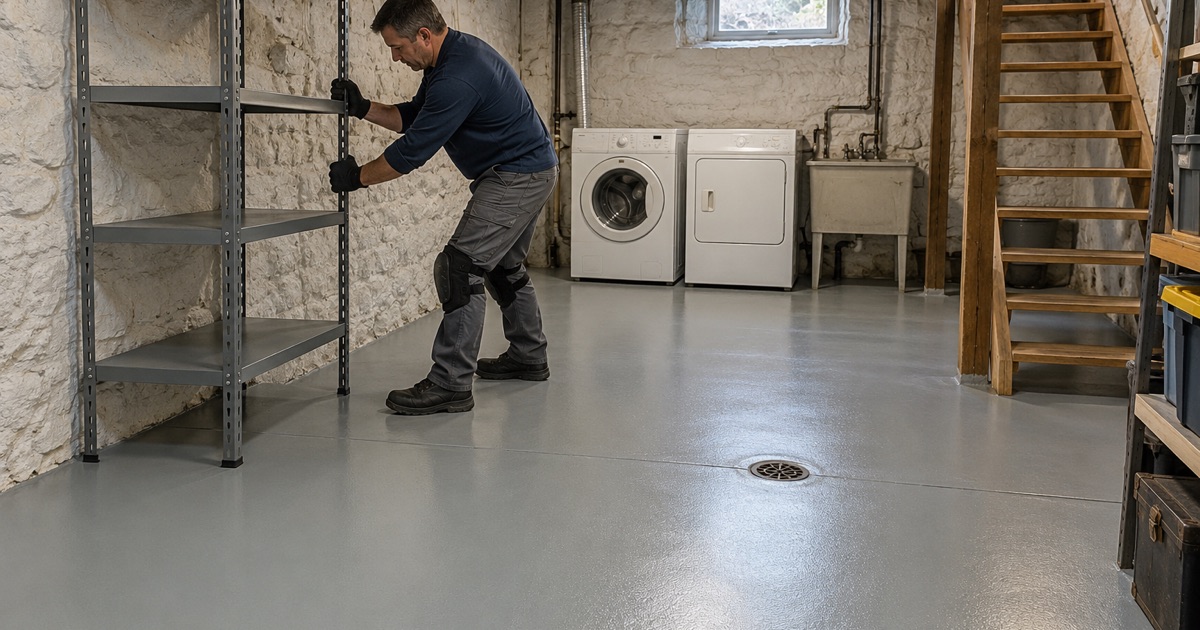
Reading the Basement for Past Water
Before any test kit comes out, we look for evidence. Water lines on walls, rust at the base of the water heater, stained baseboards and silt along the floor all tell a story. So does a sump pit that runs often or a floor drain with a ring of residue around it.
We ask when water last came in and how far it reached. That history shapes the testing and the system, and it tells us whether the problem is vapor coming through the slab or liquid water that has to be dealt with before a coating is even discussed.
Testing the Slab
The first check is often an ASTM D4263 plastic sheet test, which shows whether moisture is moving up through the slab. When we need numbers, we use ASTM F1869 calcium chloride kits for the vapor emission rate or ASTM F2170 probes that measure relative humidity inside the concrete.
Those readings are compared with the coating maker’s limits and the ASTM F710 thresholds. The test is part of the written scope before the price is final, because the reading decides the system and sometimes decides that the floor should not be coated at all.
Efflorescence and Hydrostatic Pressure
White, powdery deposits on a basement floor are usually efflorescence, salts carried up by water and left behind when it evaporates. They mean water is moving through the concrete, and they will push a coating off from underneath if the cause is not understood.
Hydrostatic pressure is water in the soil pressing up against the slab, usually after heavy rain or snowmelt. No coating holds against it. When the evidence points that way, drainage and waterproofing come first, and we explain why before anyone spends money on a floor.
Moisture-Mitigation Primers
Some slabs show vapor emission above what a standard epoxy tolerates, without active water. For those, a moisture-mitigation primer goes down first as a dense layer that holds back vapor under the finish coats. We use it only where the readings support it, and it is never a substitute for fixing seepage.
Sump Pits, Drains and Older Basements
Coating Around Sump Pits and Drain Tile
Many basements have drain tile around the footings feeding a sump pit. The pit and its lid have to stay accessible, so we stop the coating cleanly at the rim and leave room to service the pump. A pit that runs constantly is a sign to look harder at moisture before coating.
We never cover a cleanout or a drain tile access point. Those exist so the system can be inspected and cleared, and a coating that seals them shut turns a routine service call into a demolition job.
Working Around the Floor Drain
The floor drain is where water on a basement floor should end up. We terminate the coating at the drain body, keep the grate removable, and avoid building the coating up so thick that water pools before reaching it.
Grinding dust is captured by a vacuum at the machine during preparation. None of it is washed toward the floor drain, because slurry and residue do not belong in the sewer and can clog the line.
Older Dubuque Basements
About 30.4 percent of Dubuque’s housing was built in 1939 or earlier, and many of those basements carry decades of paint, patching and old floor tile. Some floors were poured thin or uneven, and some have been patched in layers over the years.
All of that has to come off before a new coating will bond. We grind to sound concrete and fill low spots and cracks. Old black tile adhesive is handled with care, since some older mastics contained asbestos and should be tested before anyone grinds them.
North End Basements and Flood Risk
The North End saw six disaster declarations for flash flooding between 1999 and 2011, with water reaching basement furnaces and water heaters, before the Bee Branch Creek was daylighted. Along the river, the John C. Culver Floodwall protects most of the city.
A coated floor is easier to clean after water, but it does not keep water out and is not flood protection. FEMA Technical Bulletin 2 describes flood damage-resistant materials, and that is the frame we use when talking through a basement that has flooded before.
Building the Basement Floor
Grinding Instead of Acid Etching
Acid etching soaks a basement slab with water and acid that have to be rinsed and dried, which is the last thing a damp basement needs. We grind with diamond tooling instead, to a profile the coating can grip, and capture the dust at the machine.
The Coating System
Most basement floors get a 100% solids epoxy base coat, or a moisture-mitigation primer first when testing calls for it. From there the floor can be a solid color, a flake broadcast for texture and a forgiving look, or a metallic finish for a finished living space. A clear topcoat seals the surface and sets the sheen.
For workshops and laundry rooms, we often add texture through the broadcast and topcoat, since a smooth gloss floor can be slick when wet. That grip is specified by the products used rather than promised in general terms.
Laundry Rooms, Workshops and Living Space
A basement often has several uses at once. Laundry areas see water and detergent near the floor drain, workshops see oil and dropped tools, and family rooms need a finish that looks good under rugs and furniture. We match the system and texture to each area, even within one basement.
Odor and Re-Entry
A basement shares air with the rest of the house. We offer low-odor products as a comfort choice, ventilate during the work, and give you a time to come back into the space. This is a preference, not a legal requirement in Iowa or Wisconsin.
What a Coating Cannot Do
Not Waterproofing, Not Radon Work
An epoxy floor does not stop seepage, and it does not lower radon. EPA places every Iowa county in radon Zone 1, and radon testing and mitigation require a state credential under Iowa Code chapter 136B. We do not hold that credential and never sell a coating as radon work.
Warranty Exclusions
Coating warranties generally exclude failures from moisture vapor transmission and hydrostatic pressure, the two most common basement problems. We go through that exclusion before you sign, which is one more reason the moisture test comes before the price.
- 20+ Years on Concrete
- Moisture Tested Before Pricing
- Diamond Ground, Never Acid Etched