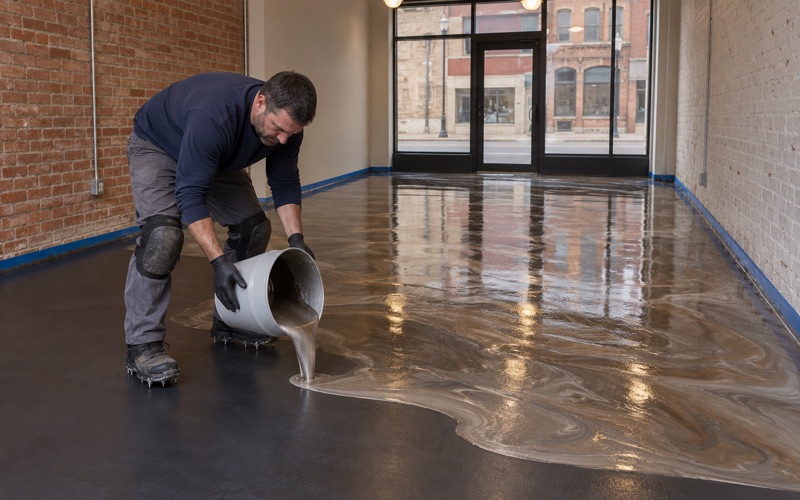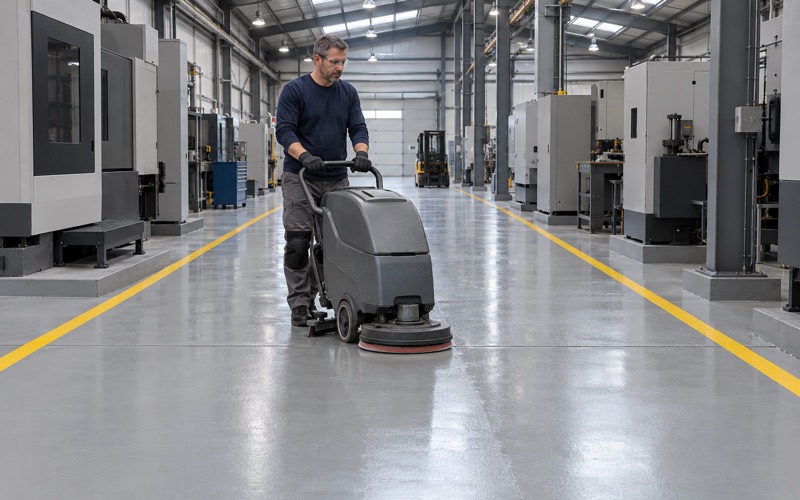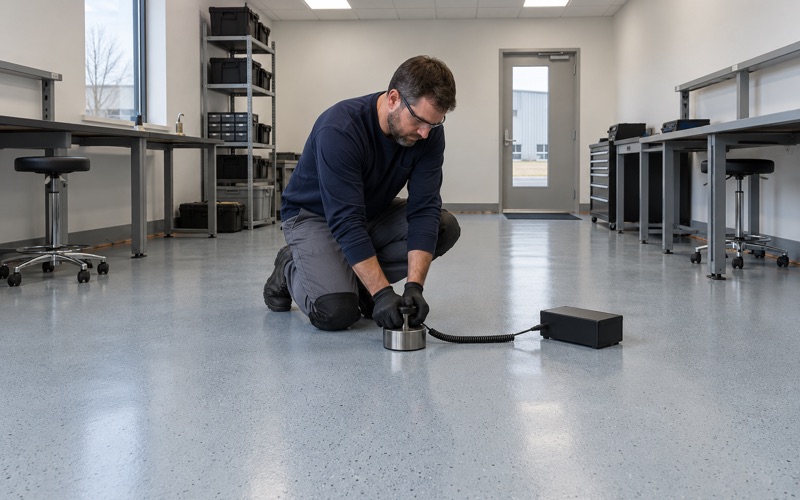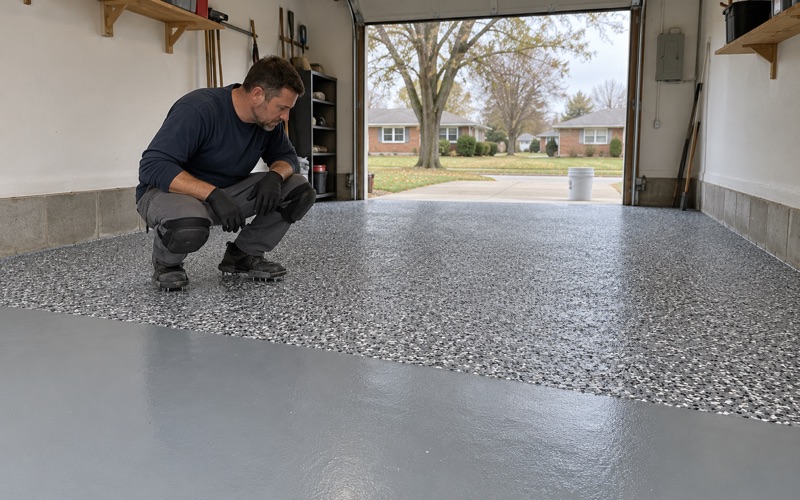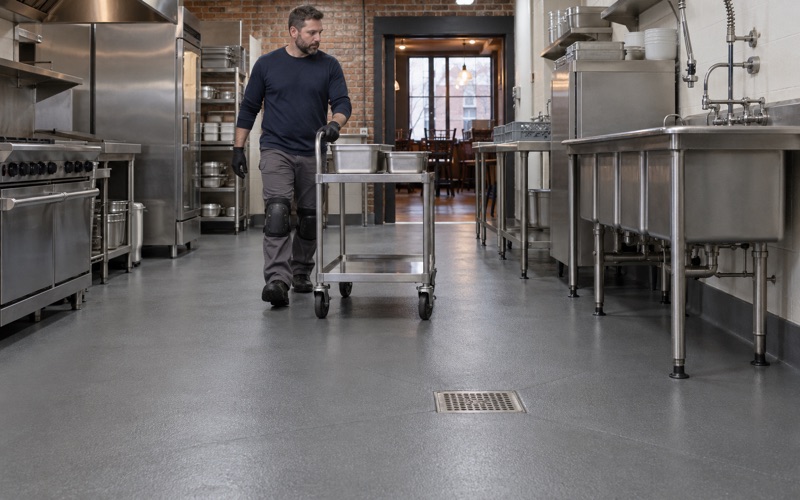
Dubuque Epoxy Flooring brings more than 20 years of epoxy flooring work to Asbury garages, basements and commercial floors, and on every job here we plan the prep waste before we plan the color. Opening a slab properly produces dust, slurry and dirty rinse water, and where that material ends up is as much a part of the job as the coating itself.
We open concrete with a diamond grinder or a shot blaster and collect what comes off it at the machine. Nothing gets rinsed toward a floor drain, a sump or the street, which keeps the work in line with how the city treats its sewers and leaves the house cleaner when we pack up.
Before a price is final, the slab is tested for moisture, mapped for cracks and old coatings, and written into a proposal that names the product, the number of coats and the finished thickness. The sections below walk through what that looks like on Asbury floors, from the garage to the lower level.
Newer Asbury Homes and the Slabs Under Them
A Housing Stock Built Mostly After 2000
Asbury is largely a bedroom community of subdivisions whose residents work in Dubuque or Peosta. Census estimates count 2,241 housing units in the city, and 1,379 of them went up between 2000 and 2019, about 61 percent. Roughly 92 percent of occupied homes are owner-occupied, so our calls here come mostly from homeowners planning a floor they intend to live with for years.
Newer construction changes some details of the job but not the checks. A slab poured in 2008 can still carry moisture, a cure-and-seal product or a slick trowel finish that has to come off, and we test it whatever year the house was built.
Garage Slabs and Winter Salt
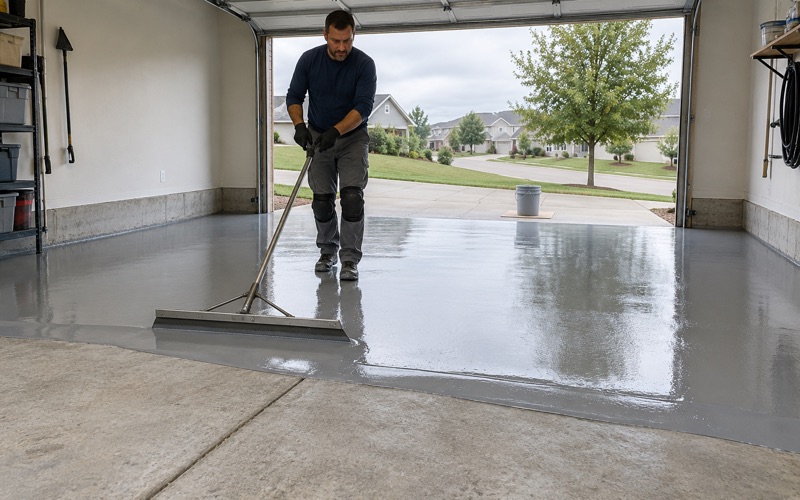
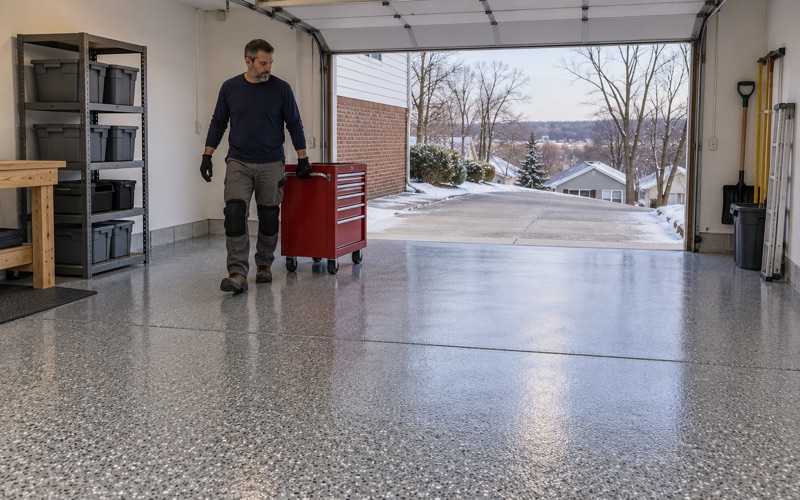
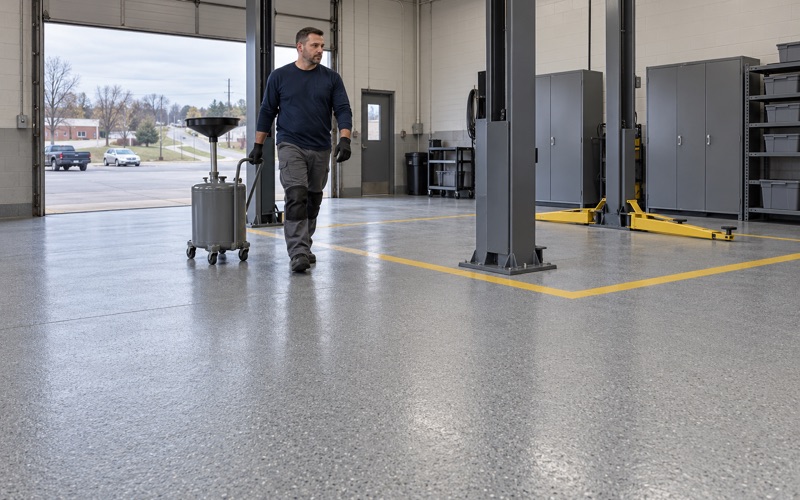
Attached garages take brine and rock salt off tires from November through March. Calcium chloride residue settles into the pores of the concrete, and freeze-thaw scaling shows up first near the door where meltwater pools. We choose garage systems for that load, often a 100% solids epoxy base with a vinyl flake broadcast and a polyaspartic topcoat that resists hot tire pickup.
The salt matters for prep as well. Residue has to come out of the surface before anything is coated, and any cleaning water carries that salt along with whatever else is on the slab. That is the point where Asbury’s sewer rules start to shape the work.
Cleaning a salted garage slab therefore starts dry. We grind through the contaminated surface layer, vacuum it up, and only then decide whether a light wash is needed. If it is, that water is picked up and collected like everything else that comes off the floor, rather than squeegeed out under the door.
Basement Floors in Finished Lower Levels
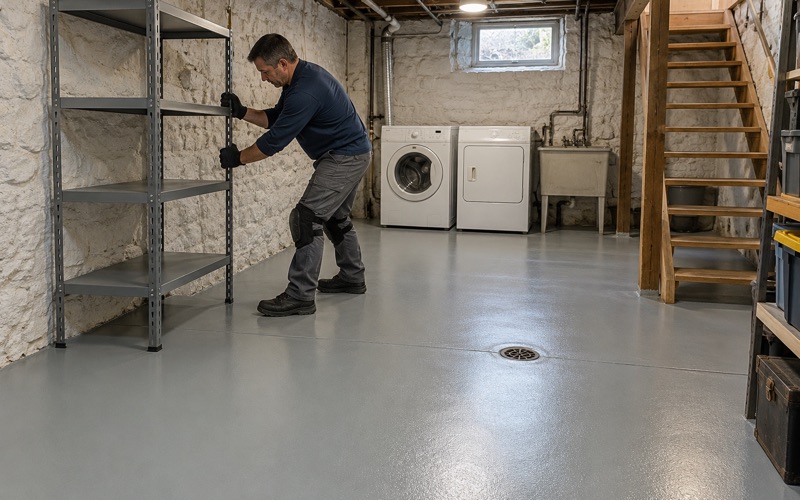
Many owners here are finishing a lower level, and the floor is often the last decision. We read a basement slab for past water first: efflorescence lines, tide marks on the walls, and the condition of the sump pit and the floor drain. A coating does not stop seepage, and we say so before anything is priced.
The moisture test is written into the scope before the price is final. Depending on the slab, we use ASTM F2170 in-situ relative humidity probes or ASTM F1869 calcium chloride testing, and the results decide whether a moisture-mitigation primer belongs in the system.
When the readings come back high, we explain the options plainly: a mitigation primer suited to that reading, a different system, or waiting. We do not coat over a high number and hope, because a basement floor that fails from below is harder and costlier to fix than one that was never coated in the first place.
Looking for epoxy-flooring closer to Platteville? See Epoxy-Flooring Services in Platteville.
What Asbury’s Sewer Ordinance Keeps Out of the Floor Drain
The Solids the Ordinance Names
Chapter 95 of the Asbury Code governs the sanitary sewer system. Section 95.18(1) bars discharges of sand, mud, chemicals, residues, lime, paint and any other solid or viscous substance capable of causing obstruction. Another subsection of the same list names inert suspended solids, including lime slurries and lime residues.
Read against floor prep, that list covers almost everything a slab gives off when it is opened up. Grinding slurry is cement fines, sand and water. Old paint and sealer come off as residue. None of it is something we would send down a basement floor drain under that language.
The ordinance also says sand and grease interceptors are not required for private living quarters or dwelling units, so a house has no trap built to catch this material before it reaches the public line. Keeping solids out falls to whoever generates them, and on a floor project that is our crew.
The pH Limit and Acid-Etch Rinse
The same section bars waters or wastes with a pH lower than 6.0 or higher than 9.5 from the sanitary sewer. Acid etching works by flooding the concrete with an acid solution and then rinsing it off, so the rinse water carries spent acid, dissolved cement paste and loosened fines.
The ordinance does not name acid etching, and the city has not approved or banned any prep method. What it does is bar the categories that etch rinse falls into, which is one more reason we never etch a slab. Fresh concrete slurry can run strongly alkaline as well, so even plain grinding water is something we capture rather than flush.
The Street and the Storm Inlet
Section 95.19 adds that no person shall discharge any sewage, pollutant or garbage into a public storm sewer. Asbury runs separate sanitary and storm systems, so a garage slab hosed toward the driveway sends its waste toward a storm inlet rather than a treatment plant.
For a garage job, that rules out the old habit of pushing rinse water out the door with a squeegee. We keep the slurry, dust and cleaning water on the slab, collect it and haul it away with our equipment.
The driveway gets the same treatment at cleanup. Wipe rags, empty resin kits and mixing pails go back in our trailer, not into a bin sitting next to a storm grate. Leftover resin is left to cure solid in its pail before disposal, so nothing liquid leaves the job.
Grinding With Dust and Slurry Capture
Why We Grind Instead of Etching
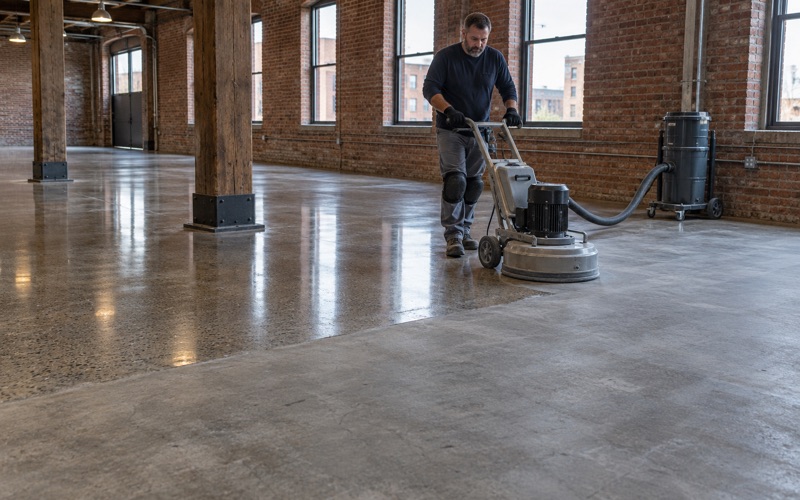
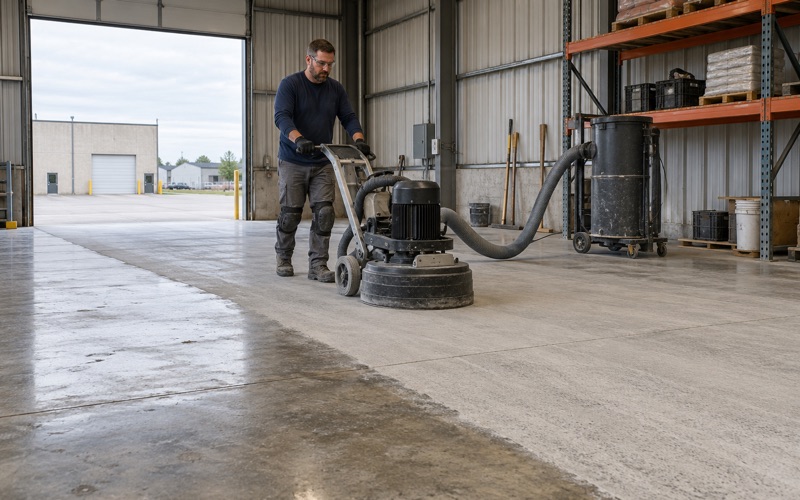
We open every slab with a diamond grinder or a shot blaster, never an acid etch. Grinding gives a measurable concrete surface profile on the ICRI CSP scale, matched to the thickness of the system going down, and it removes old coatings, sealers and salt residue in the same pass.
Etching leaves an uneven profile that is hard to check and a residue that has to be rinsed away. A ground slab can be compared against profile chips before the primer goes down, and nothing has to be washed into a drain to get there.
Dust Captured at the Machine
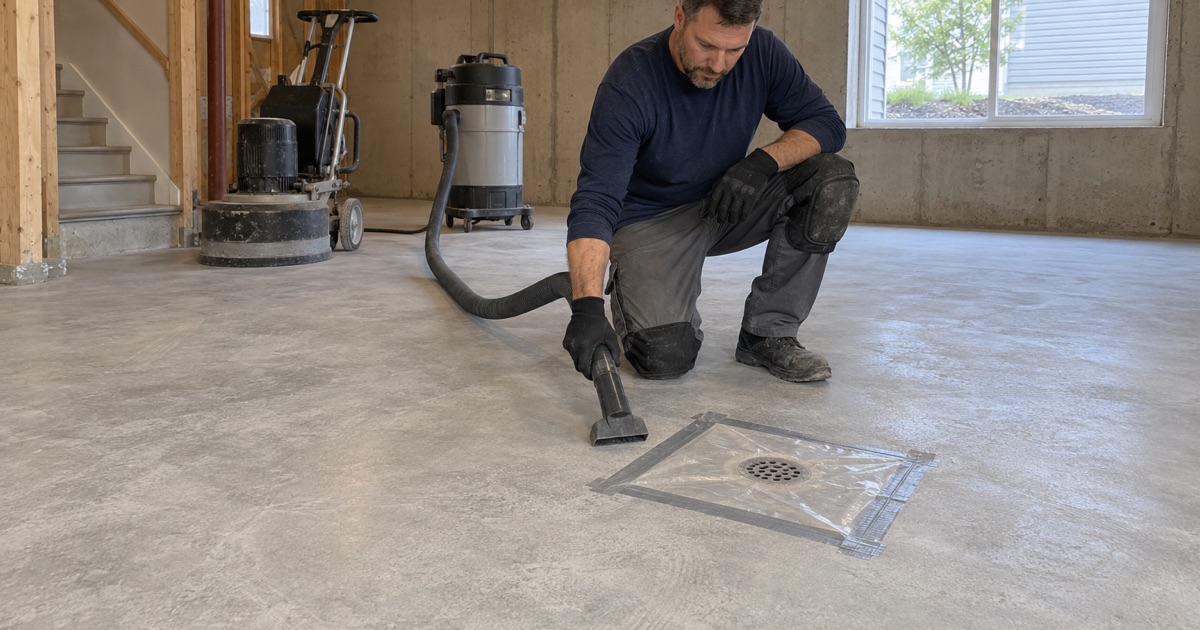
Our grinders run shrouded heads connected to a vacuum, so dust is pulled off the slab at the cutting edge. In a finished basement that matters for air quality and cleanup, and it means the fines end up in a bag that leaves with us rather than in the floor drain or on the lawn.
Where a slab has to be wet-ground or washed, the slurry is picked up with a wet vacuum and containerized. We cover the floor drain while the work is underway so nothing slips in while the crew is moving equipment around.
Capture protects the coating as well as the drain. Fines left on a ground slab weaken the primer’s bond, so after grinding we vacuum the floor a second time, detail the edges and corners by hand, and check the surface before any resin is mixed.
Mapping the Slab Before the Price Is Set
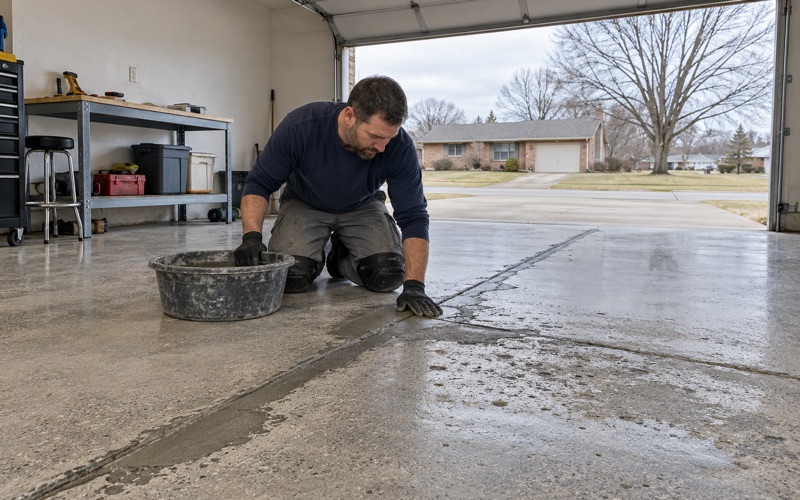
Grinding shows a slab’s real condition. We map cracks, spalls, control joints and any remaining coating before the proposal is written, and we tell you when a section needs repair or replacement before it should be coated at all.
The proposal then names the product line, the number of coats and the finished thickness, so you can check the floor against the quote. Cure schedules follow slab temperature and the dew point spread at the surface, which matters in an unheated garage in January.
Repairs follow the same waste rules as prep. Crack filler and patch material are mixed in pails and scraped onto drop cloths, and the grinding that levels each repair runs through the same shrouded heads and vacuum as the rest of the floor.
Sump Pits, Foundation Drains and Permitted Basement Finishes
Where the Groundwater Goes
Section 95.18(9) keeps storm water, ground water and subsurface drainage, including interior and exterior foundation drains, out of the sanitary sewer. In a basement with drain tile and a sump pit, that water belongs outside, not in the floor drain or a laundry tub connection.
We check the sump pit and its discharge line during the moisture review, because a pit that runs often tells us something about hydrostatic pressure under the slab. That reading goes into the scope and into the warranty conversation.
We do not reroute a sump discharge or change any plumbing; that work belongs to a plumber or a drainage contractor. What we do is protect the pit lid, the floor drain and the slab edges during prep and coating, so the drainage works the same way after we leave as it did before we arrived.
What the Coating Warranty Leaves Out
Moisture vapor transmission and hydrostatic pressure are the first exclusions we name, before the job is sold. If the slab is pushing water up from below, a coating can blister or lose its bond no matter how carefully it went down.
A coating is a wearing surface. It does not repair a sump and it does not replace drainage work. When a basement shows signs of active water, we recommend dealing with that first and coming back to the floor once the slab tests dry.
Finishing Permits Under the 2015 IRC
Asbury builds to the 2015 International Residential Code with local amendments in Chapter 156, administered by the city’s Building Services Department. The city’s permit page lists basement finishing among the work that typically needs a permit and notes that the list is not all-inclusive.
Floor coating alone is not named either way. When the floor is part of a larger finished-basement project, we suggest calling City Hall at 563.556.7106 before work starts, and inspections for permitted work are scheduled through ECIA at 563.556.4166.
- 20+ Years on Concrete
- Moisture Tested Before Pricing
- Diamond Ground, Never Acid Etched